-
Resistance Temperature Detector (RTD)
Platinum RTD Elements is a high-precision temperature sensing component that measures temperature based on the stable resistance-temperature characteristics of platinum. These elements offer exceptional accuracy, repeatability, and long-term stability, while maintaining excellent performance across a wide temperature range. Thanks to their high reliability and linear response, platinum RTDs are widely used in industrial automation, household appliances, automotive electronics, medical instruments, and many other fields.
Key Features
- Wide operating temperature range: –50°C to +650°C
- Nominal resistance at 0°C: 100 Ω
- Available Temperature Coefficient (TCR): 0.00385
- Standard accuracy: IEC 751 and DIN 43760
- Highly linear relationship between resistance and temperature
- Compatible with microprocessor-based sensing technologies
- Fast response, high reliability, high accuracy, excellent stability, and interchangeability
- Outstanding resistance to shock and vibration
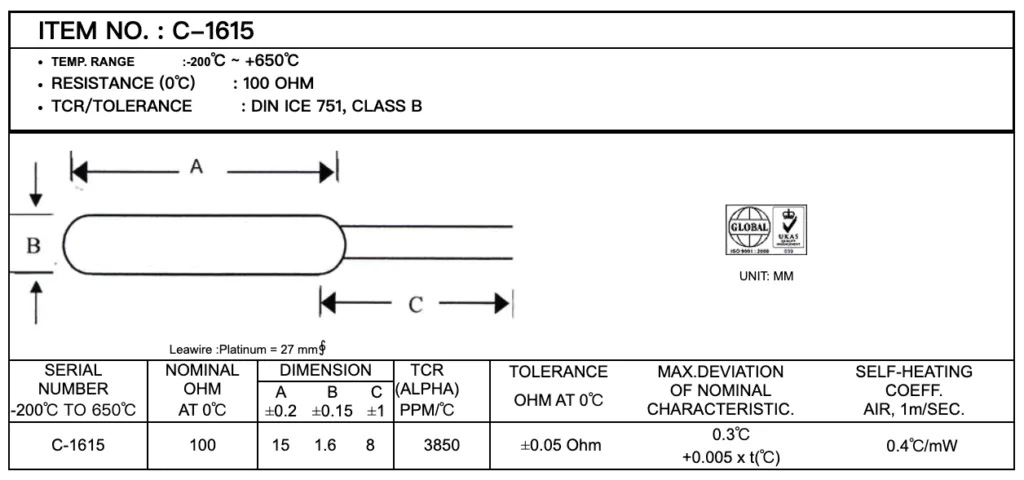
Ceramic Wire-Wound Type (Resistance / Sensing Element)
A Ceramic Wire-Wound Platinum RTD Sensor is constructed by winding a platinum wire around a high-purity ceramic core. This structure provides exceptionally high accuracy, long-term stability, and outstanding resistance to thermal shock, making it ideal for applications requiring precise temperature measurement and reliable performance in demanding environments.
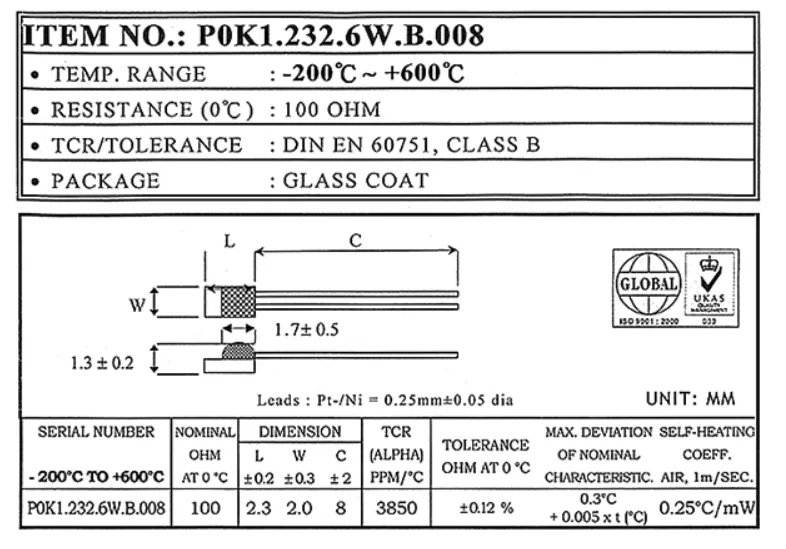
Thin-Film Type (Sensing Element / Resistor)
A Thin-Film Platinum RTD Sensor is manufactured by depositing an extremely thin layer of platinum onto a ceramic substrate, followed by the application of a protective layer. This type of sensor offers excellent accuracy, fast response time, and a compact form factor, making it highly suitable for household appliances, automotive electronics, and general industrial applications.